Thin binding to the artem-ogre/CDT library. Input mirrors RTriangle::pslg: vertices as x/y and constraint segments as index pairs into the vertices.
Usage
cdt_triangulate(
  x,
  y,
  s0 = NULL,
  s1 = NULL,
  max_area = NULL,
  min_angle = NULL,
  max_steiner = Inf,
  min_edge_length = NULL,
  min_edge_frac = 0.3,
  area_edge_frac = 0.25,
  conforming = FALSE,
  erase = c("outer", "hull", "holes"),
  intersect = c("resolve", "error", "ignore"),
  angle_first = FALSE,
  depth_distinct = FALSE
)
Arguments
- x, y
vertex coordinates
- s0, s1
1-based vertex indices of constraint segment start/end (may be NULL)
- max_area
maximum triangle area (Ruppert refinement by area), NULL for none
- min_angle
minimum triangle angle in degrees, NULL for none
- max_steiner
budget of Steiner points to insert (Inf for unlimited)
- min_edge_length
refinement does not split edges or triangles already shorter than this. NULL (the default) chooses a value from the input and the targets (see
default_min_edge_length()): a fraction of the median constraint segment length, capped so that it never blocks themax_areatarget. This stops the refiner cascading into sharp input corners. Use 0 to never give up.- min_edge_frac
fraction of the median constraint segment length used when
min_edge_lengthis NULL- area_edge_frac
fraction of
sqrt(max_area)that caps the default floor- conforming
if TRUE use conforming (Steiner on segments) instead of constrained
- erase
one of "outer" (drop triangles outside the segment-bounded region, as RTriangle's
-pdoes), "hull" (keep the convex hull), "holes" (also drop even-depth regions). With no segments there is no boundary, so "hull" is used.- intersect
how crossing constraints are handled: "resolve" inserts the crossing point, "error" fails, "ignore" skips the check
- angle_first
when both criteria are given, refine by angle before area (default is area then angle; the two orderings differ little)
- depth_distinct
also return
depth_distinct, a per-triangle depth that counts a doubled (overlapping) boundary once rather than once per copy. The defaultdepthcounts per copy; the two differ only where the only path from outside a triangle crosses a shared, doubled boundary.
Value
list with P (vertices), T (1-based triangle indices, wound
counter-clockwise / positive signed area), S (fixed edges), depth
(per-triangle constraint layer depth: 0 outside, odd inside, even hole;
a doubled shared boundary is counted once per copy), origin (a factor
giving each vertex's provenance: "input", "crossing" or "steiner"),
n_input (vertices after dedupe, before Steiner), n_crossing (vertices
added resolving crossing constraints), input_map (input vertex -> deduped
vertex index), min_edge_length (the value used), and unrefined, a data
frame with one row per refinement pass counting what CDT could not refine
(short edges, sharp fixed corners, and so on). When depth_distinct = TRUE
the list also has depth_distinct (a doubled boundary counted once).
Examples
## unit square with a square hole: two closed rings of 4 vertices
x <- c(0, 1, 1, 0, 0.25, 0.75, 0.75, 0.25)
y <- c(0, 0, 1, 1, 0.25, 0.25, 0.75, 0.75)
s0 <- c(1, 2, 3, 4, 5, 6, 7, 8)
s1 <- c(2, 3, 4, 1, 6, 7, 8, 5)
## constrained triangulation, hole triangles kept with even depth
r <- cdt_triangulate(x, y, s0, s1)
table(r$depth)
#>
#> 1 2
#> 8 2
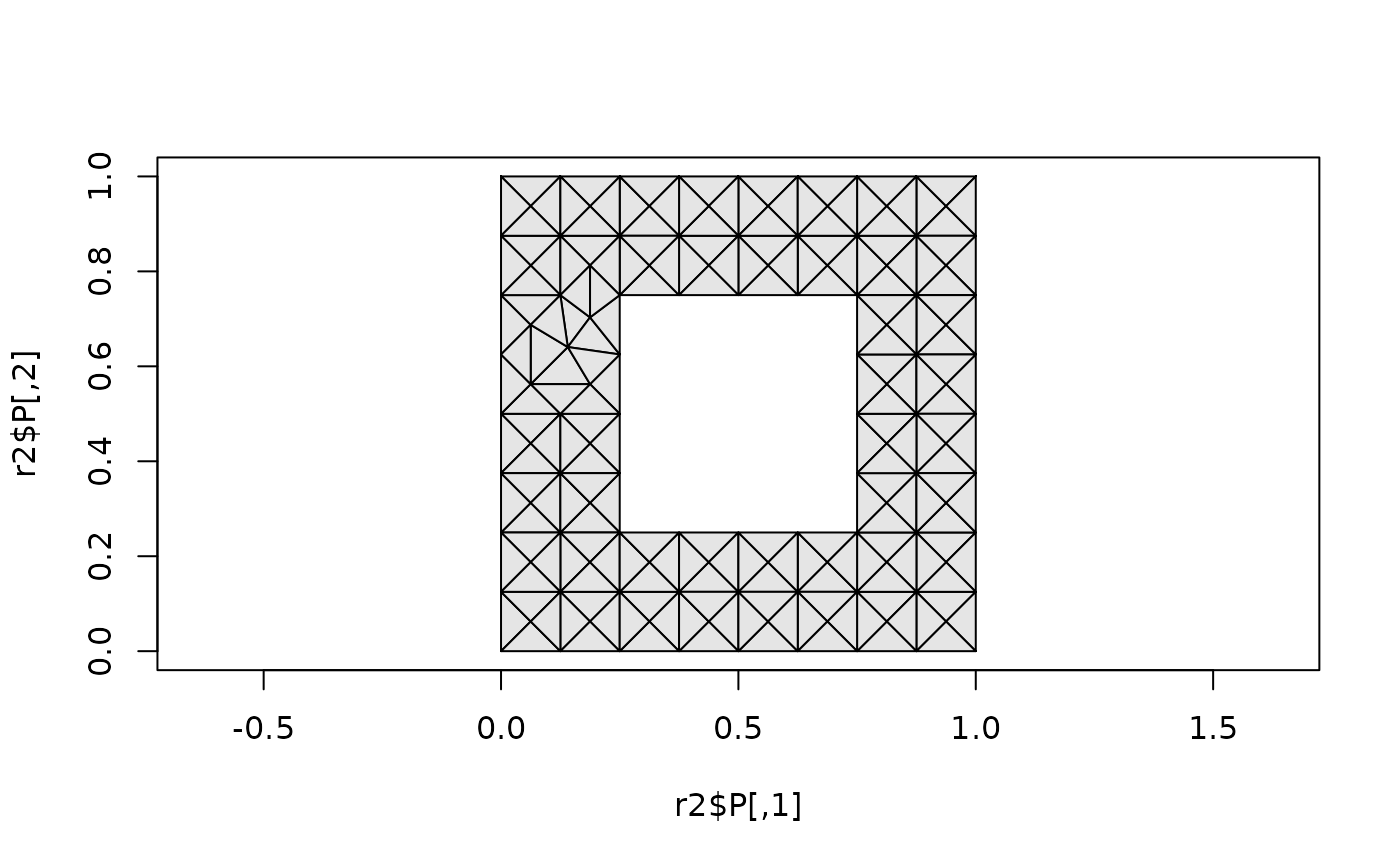
## drop the hole and refine by area and minimum angle
r2 <- cdt_triangulate(x, y, s0, s1, erase = "holes",
max_area = 0.005, min_angle = 25)
table(r2$origin)
#>
#> input crossing steiner
#> 8 0 112
plot(r2$P, asp = 1, pch = ".")
polygon(r2$P[t(cbind(r2$T, NA)), ], col = "grey90")
 ## points only: Delaunay triangulation of the convex hull
set.seed(1)
r3 <- cdt_triangulate(runif(30), runif(30))
nrow(r3$T)
#> [1] 51
## points only: Delaunay triangulation of the convex hull
set.seed(1)
r3 <- cdt_triangulate(runif(30), runif(30))
nrow(r3$T)
#> [1] 51