Runs the chunk plan returned by warp_plan(): reads each chunk's source
window with read_fn, warps it with rwarp's kernels, and places it in the
output. The loop runs in Rust and calls read_fn once per chunk.
Usage
warp_exec(
  plan,
  read_fn,
  src_crs,
  src_gt,
  dst_crs,
  dst_gt,
  dst_size = attr(plan, "dst_size"),
  nbands = attr(plan, "nbands"),
  resample = attr(plan, "resample"),
  src_nodata = NA,
  dst_nodata = NA,
  band_nodata = c("partial", "unified", "per_band"),
  mask_band = NULL,
  mode_ties = c("first", "min", "max"),
  max_error = 0.125,
  output = c("array", "nara"),
  verbose = FALSE,
  nodata = NULL
)
Arguments
- plan
Chunk plan as returned by
warp_plan(). A chunk withoutscale_x/scale_y(a plan made by hand) uses a kernel scale of 1.- read_fn
A function
f(xoff, yoff, xsize, ysize)returning the source window as one vector of lengthxsize * ysize * nbands: each band row-major (asGDALRaster$read()gives it), bands one after another. Integer, double or raw. Can call GDAL, a byte-ref tile reader, a Zarr chunk fetcher, or anything else.- src_crs, src_gt
Source CRS and geotransform (as passed to
warp_plan()).- dst_crs, dst_gt
Destination CRS and geotransform of the full grid (as passed to
warp_plan()).- dst_size
Integer
c(ncol, nrow)of the planned window. Default: the plan's.- nbands
Number of bands
read_fnreturns. Default: the plan'snbands(seewarp_plan()), or1L.- resample
Resampling method (see
warp_plan()). Default: the method the plan was made for. Planning for one method and warping with a wider one can clip kernels at window edges.- src_nodata
Source nodata, one value or one per band.
NA(the default) means R'sNAfor integer data; NaN is always nodata in double data; raw has none.NULLfor none.- dst_nodata
Value written where no source contributes, one value or one per band.
NA(the default) writesNAfor integer data,NaNfor double (is.na()isTRUEfor both) and 0 for raw.NULLwrites 0.- band_nodata
How nodata works across bands (gdalwarp
UNIFIED_SRC_NODATA):"partial"(gdalwarp's default),"unified", or"per_band".- mask_band
A band (1-based) whose zeros mark source pixels invalid, such as an alpha band.
NULLfor none.- mode_ties
For
resample = "mode", how ties break:"first","min"or"max"(gdalwarp-wo MODE_TIES=).- max_error
Approx-transformer pixel error bound. Default
0.125(gdalwarp's-et).- output
"array"(default): a matrixc(nrow, ncol)for one band, an arrayc(nrow, ncol, nbands)for more."nara": anativeRasterfor raw data of 1 (grey), 3 (RGB) or 4 (RGBA) bands, ready forplot(),grid::grid.raster()orpng::writePNG(). Without an alpha band, pixels whose bands all equaldst_nodataare transparent.- verbose
Print a line per chunk. Default
FALSE.- nodata
Deprecated: sets both
src_nodataanddst_nodata.
Details
The data type follows what read_fn returns: an integer vector warps as
32-bit integers, a double vector as 64-bit floats, a raw vector as bytes.
The output is the same type.
Examples
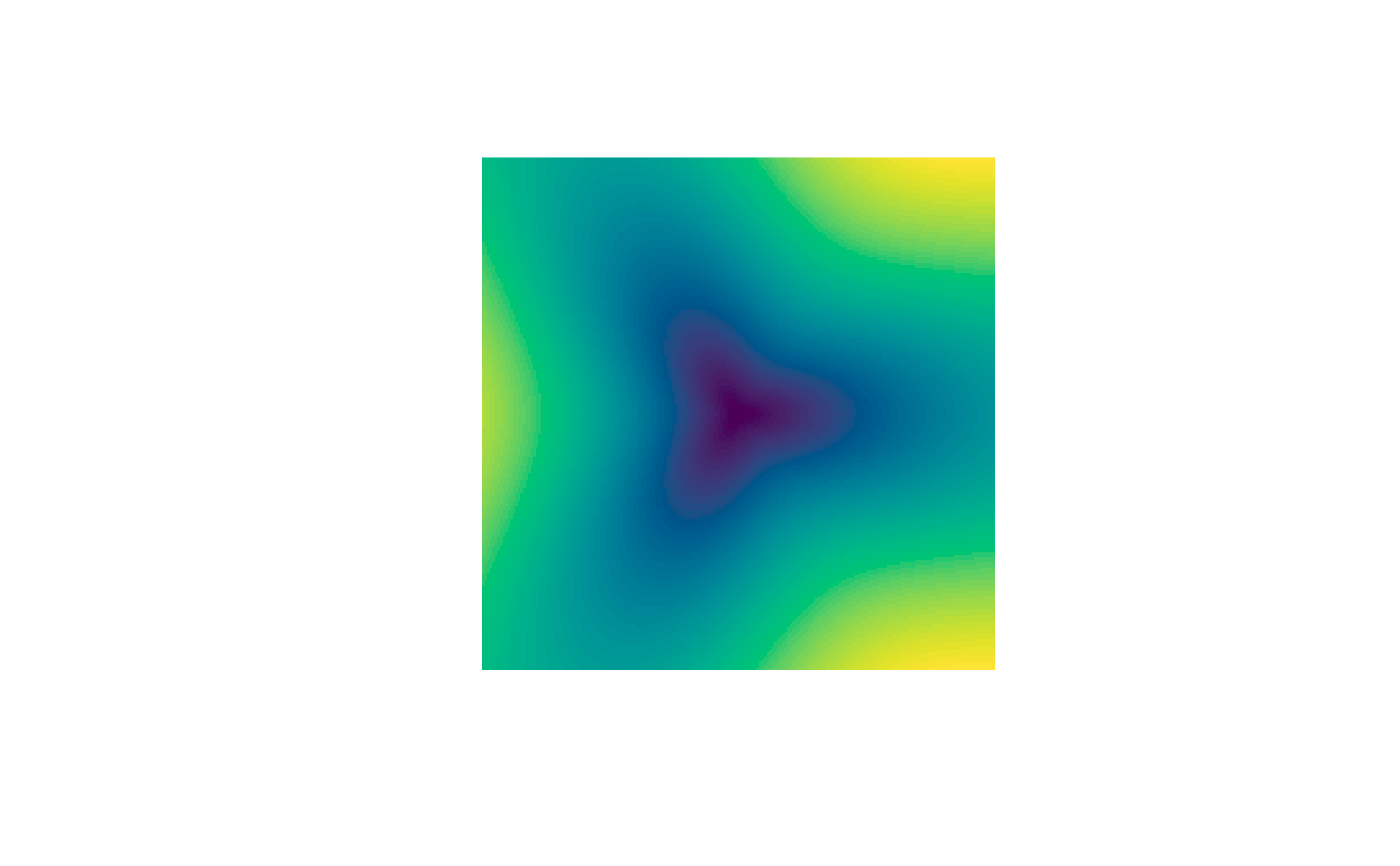
## a smooth global field held in memory, warped to south polar
## stereographic: read_fn returns any window of it, row-major
src_gt <- c(-180, 1, 0, 90, 0, -1)
lon <- seq(-179.5, 179.5)
lat <- seq(89.5, -89.5)
z <- outer(lat, lon, function(la, lo)
cos(la * pi / 180) * (1 + 0.3 * sin(3 * lo * pi / 180)))
read_fn <- function(xoff, yoff, xsize, ysize) {
as.vector(t(z[yoff + seq_len(ysize), xoff + seq_len(xsize), drop = FALSE]))
}
dst_gt <- c(-5e6, 50000, 0, 5e6, 0, -50000)
plan <- warp_plan("EPSG:4326", src_gt, c(360L, 180L), "EPSG:3031", dst_gt,
dst_size = c(200L, 200L), resample = "bilinear")
x <- warp_exec(plan, read_fn, "EPSG:4326", src_gt, "EPSG:3031", dst_gt)
image(t(x[nrow(x):1, ]), asp = 1, axes = FALSE, col = hcl.colors(64))
 if (FALSE) { # \dontrun{
## a remote COG, read with gdalraster
library(gdalraster)
library(vaster)
## Sentinel-2 Band 4 COG
url <- paste0(
"/vsicurl/https://e84-earth-search-sentinel-data.s3.us-west-2.",
"amazonaws.com/sentinel-2-c1-l2a/55/G/CM/2026/2/",
"S2C_T55GCM_20260227T000650_L2A/B04.tif"
)
ds <- new(GDALRaster, url, read_only = TRUE)
src_crs <- ds$getProjectionRef()
src_gt <- ds$getGeoTransform()
src_dim <- c(ds$getRasterXSize(), ds$getRasterYSize())
dst_crs <- "EPSG:4326"
dst_ext <- reproj::reproj_extent(ds$bbox()[c(1,3,2,4)], "EPSG:4326", source = src_crs)
dst_dim <- c(512L, 512L)
dst_gt <- extent_dim_to_gt(dst_ext, dst_dim)
read_fn <- function(xoff, yoff, xsize, ysize) {
as.integer(ds$read(1L, xoff, yoff, xsize, ysize, xsize, ysize))
}
plan <- warp_plan(src_crs, src_gt, src_dim, dst_crs, dst_gt,
dst_size = dst_dim, resample = "cubic")
result <- warp_exec(plan, read_fn, src_crs, src_gt, dst_crs, dst_gt)
ximage::ximage(result, dst_ext, col = grey.colors(256))
ds$close()
} # }