A virtual Zarr store holds no array data. It holds references: for each chunk, which file holds its bytes and at what offset. The files are the original NetCDF, HDF5 or GeoTIFF archives, served as they are. zaro reads these reference stores directly:
| Source | Address |
|---|---|
| kerchunk JSON | reference+json:///path/refs.json |
| kerchunk Parquet | reference+parquet:///path/refs.parquet |
| VirtualiZarr Parquet manifests | virtualizarr://https://.../dataset.parq |
| byterefs SQLite tables | byterefs:///path/store.sqlite |
| byterefs flat Parquet export | flatrefs://https://.../store |
Once opened, a virtual store behaves like any other:
zaro_dataset(), zaro_read() and
zaro_array() work the same.
BRAN2023 ocean temperature
BRAN2023 is CSIRO’s ocean reanalysis: daily temperature at 51 depths on a 0.1 degree grid, 2010 to 2024, about 11 TB as NetCDF on NCI’s THREDDS server. This VirtualiZarr reference store, kept on GitHub, points into those NetCDF files.
library(zaro)
options(zaro.verbose = FALSE)

bran <- zaro("virtualizarr://https://raw.githubusercontent.com/mdsumner/virtualized/refs/heads/main/remote/ocean_temp_2023.parq")
ds <- zaro_dataset(bran)
ds
#> <zaro_dataset> 11 array(s) [zaro::VirtualiZarrStore]
#>   Time           float64  (Time: 5479)
#>   Time_bnds      float64  (nv: 2, Time: 5479)
#>   average_DT     float64  (Time: 5479)
#>   average_T1     float64  (Time: 5479)
#>   average_T2     float64  (Time: 5479)
#>   nv             float64  (nv: 2)
#>   st_edges_ocean float64  (st_edges_ocean: 52)
#>   st_ocean       float64  (st_ocean: 51)
#>   temp           int16    (xt_ocean: 3600, yt_ocean: 1500, st_ocean: 51, Time: 5479)
#>   xt_ocean       float64  (xt_ocean: 3600)
#>   yt_ocean       float64  (yt_ocean: 1500)
#>   attributes: 9
temp is packed as 16-bit integers; its attributes say
how to unpack it:
ds$arrays$temp@attributes[c("scale_factor", "add_offset", "_FillValue", "units")]
#> $scale_factor
#> [1] 0.00778222
#>
#> $add_offset
#> [1] 245
#>
#> $`_FillValue`
#> [1] -32768
#>
#> $units
#> [1] "degrees C"
Extract a track
A lazy array with cf = TRUE unpacks values and masks the
fill. Here is a made-up 30-day track off eastern Tasmania, diving from 5
to 200 m: one value per day, from 30 different chunks in 30 different
NetCDF files.
temp <- zaro_array(ds, "temp", cf = TRUE)     # xt_ocean, yt_ocean, st_ocean, Time
dim(temp)
#> [1] 3600 1500   51 5479

coord <- function(nm) as.vector(zaro_read(bran, nm, meta = ds$arrays[[nm]]))
xt <- coord("xt_ocean"); yt <- coord("yt_ocean"); st <- coord("st_ocean")
units <- ds$arrays$Time@attributes$units; units
#> [1] "days since 1979-01-01"
## time steps are at midday (x.5 days): floor them to their calendar day
time <- as.Date(sub("^days since ", "", units)) + floor(coord("Time"))

track <- data.frame(date = as.Date("2023-03-01") + 0:29,
                    lon = seq(147.8, 152.5, length.out = 30),
                    lat = seq(-43.5, -39.0, length.out = 30),
                    depth = round(5 + 195 * (1 - cos(seq(0, pi, length.out = 30))) / 2))
near <- function(coord, v) vapply(v, function(z) which.min(abs(coord - z)), 1L)
idx <- cbind(near(xt, track$lon), near(yt, track$lat), near(st, track$depth),
             near(as.numeric(time), as.numeric(track$date)))

system.time(track$temp <- temp[idx])
#>    user  system elapsed
#>   0.539   0.128   1.024
head(track)
#>         date      lon       lat depth     temp
#> 1 2023-03-01 147.8000 -43.50000     5 16.85644
#> 2 2023-03-02 147.9621 -43.34483     6 17.08991
#> 3 2023-03-03 148.1241 -43.18966     7 17.78253
#> 4 2023-03-04 148.2862 -43.03448    10 18.36619
#> 5 2023-03-05 148.4483 -42.87931    14 18.66192
#> 6 2023-03-06 148.6103 -42.72414    19 18.92651
plot(track$date, track$temp, type = "b", pch = 19, xlab = "", ylab = "temperature (degC)",
     main = "BRAN2023 along a made-up track")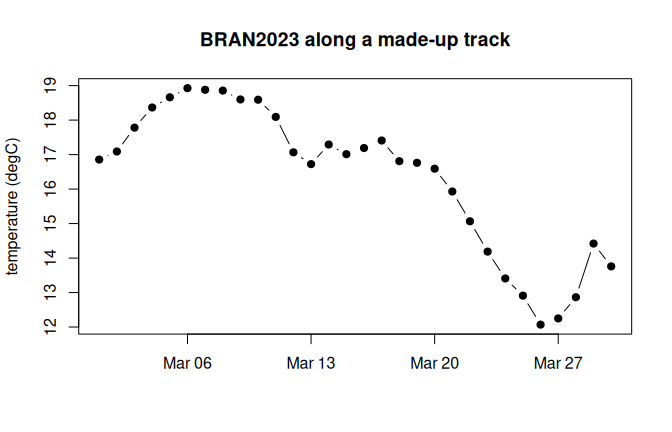
All 30 byte ranges are fetched concurrently through one connection
pool. That’s the default, up to 8 connections per host
(options(zaro.max_con)).
byterefs tables
byterefs is a
specification for exactly this kind of table: one row per chunk with its
file, offset and size, plus what a reader needs to decode it. raad.virtualize
produces byterefs stores as SQLite files, and publishes them as a flat
Parquet export (a directory with arrays.json and one
refs_<array>.parquet per array). zaro reads the first
with byterefs:// and the second with
flatrefs://, and applies the store’s default path remapping
(meta.default_target), so a table scanned on a local mirror
reads from its public copy:
store <- zaro("byterefs:///path/to/store.sqlite")                  # default target
store <- zaro("byterefs:///path/to/store.sqlite", target = "public") # another target
store <- zaro("flatrefs://https://host/path/to/store")              # flat Parquet export
A flat refs table can be large (BRAN2023’s temp is 37.5M
rows, 324 MB), so zaro never reads it whole for a selection. It reads
the Parquet footer with one range request, then only the row groups
whose dim_k statistics can hold the chunks a plan needs: a
one-day surface plan reads one 9 MB row group. A point series over every
day reads the table one row group at a time.
The specification is still moving, so this part of zaro will follow it.