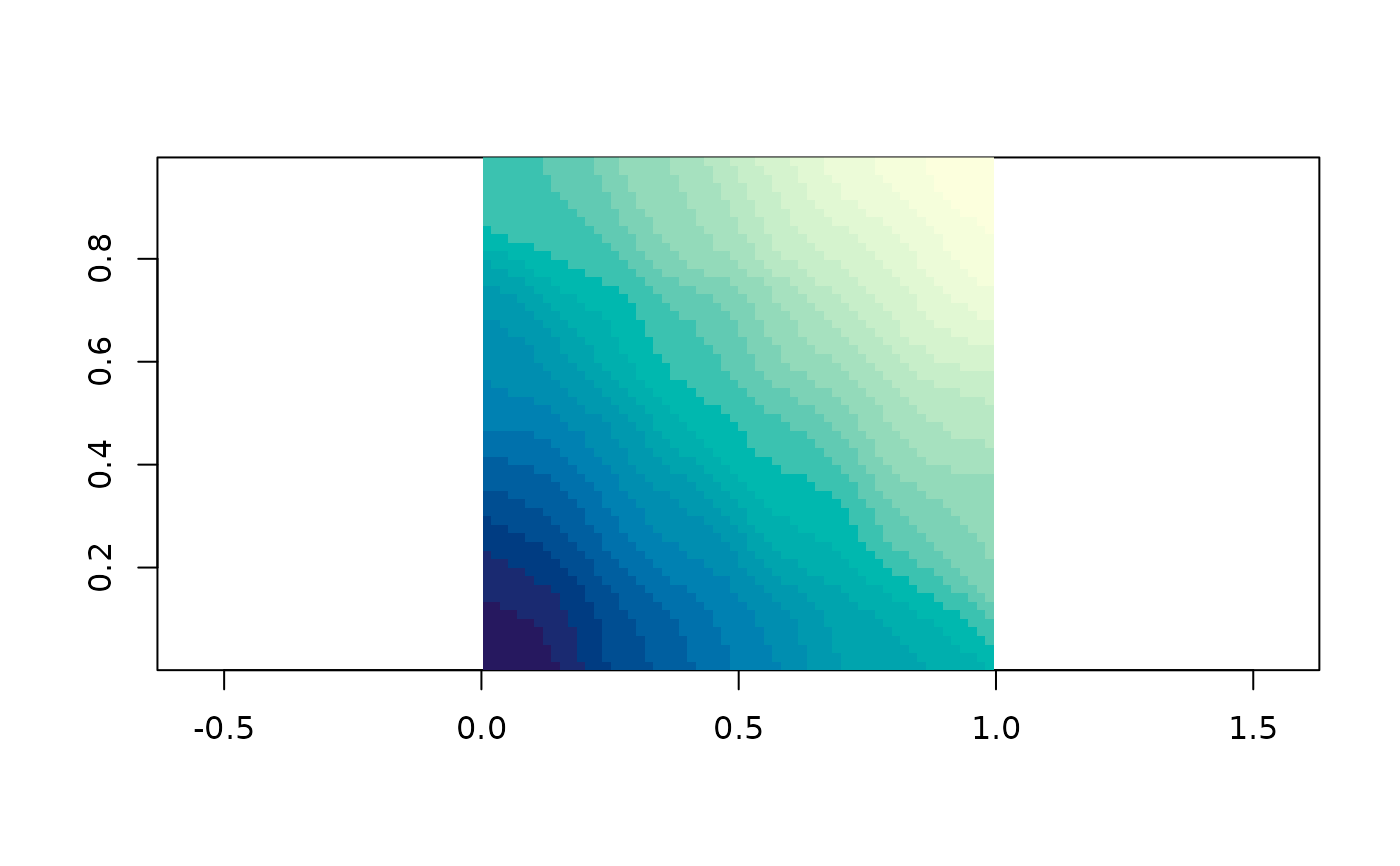
Bin the points to a grid, then smooth that grid with a Gaussian kernel,
using fields::image.smooth().
Arguments
- x
coordinates, or coordinates carrying their value as z; see
xyz_input()- value
one value per coordinate, or
NULLto use the z ofx- grid
a
grid_spec()to interpolate onto, orNULLfor a default one- theta
kernel bandwidth, in the units of the coordinates
- ...
passed to
fields::image.smooth()
Details
This is the two step method: rasterize first (grid_bin()), estimate second.
Everything else here works from the points directly, so this one is worth
having as the contrast – the binning throws away where inside its cell each
point was, and no amount of smoothing afterwards gets that back.
theta is the kernel bandwidth in coordinate units, and it does all the
work. There is no standard error, because there is no model.
fields::image.smooth() wants a square grid, so this uses one of
max(dimension) cells a side and returns it; the result covers the same
extent but need not have the dimension you asked for.
Examples
xy <- cbind(runif(200), runif(200))
if (requireNamespace("fields", quietly = TRUE)) {
  plot(grid_smooth(xy, xy[, 1] + xy[, 2], theta = 0.1))
}